On-policy distillation (OPD) has become an effective approach for consolidating multiple task-specialized image generation models into a single student. However, existing OPD methods optimize the student mainly to match the teacher's output velocity, making the teacher the upper limit of the optimization objective, while leaving the student's blockwise representation evolution underconstrained.
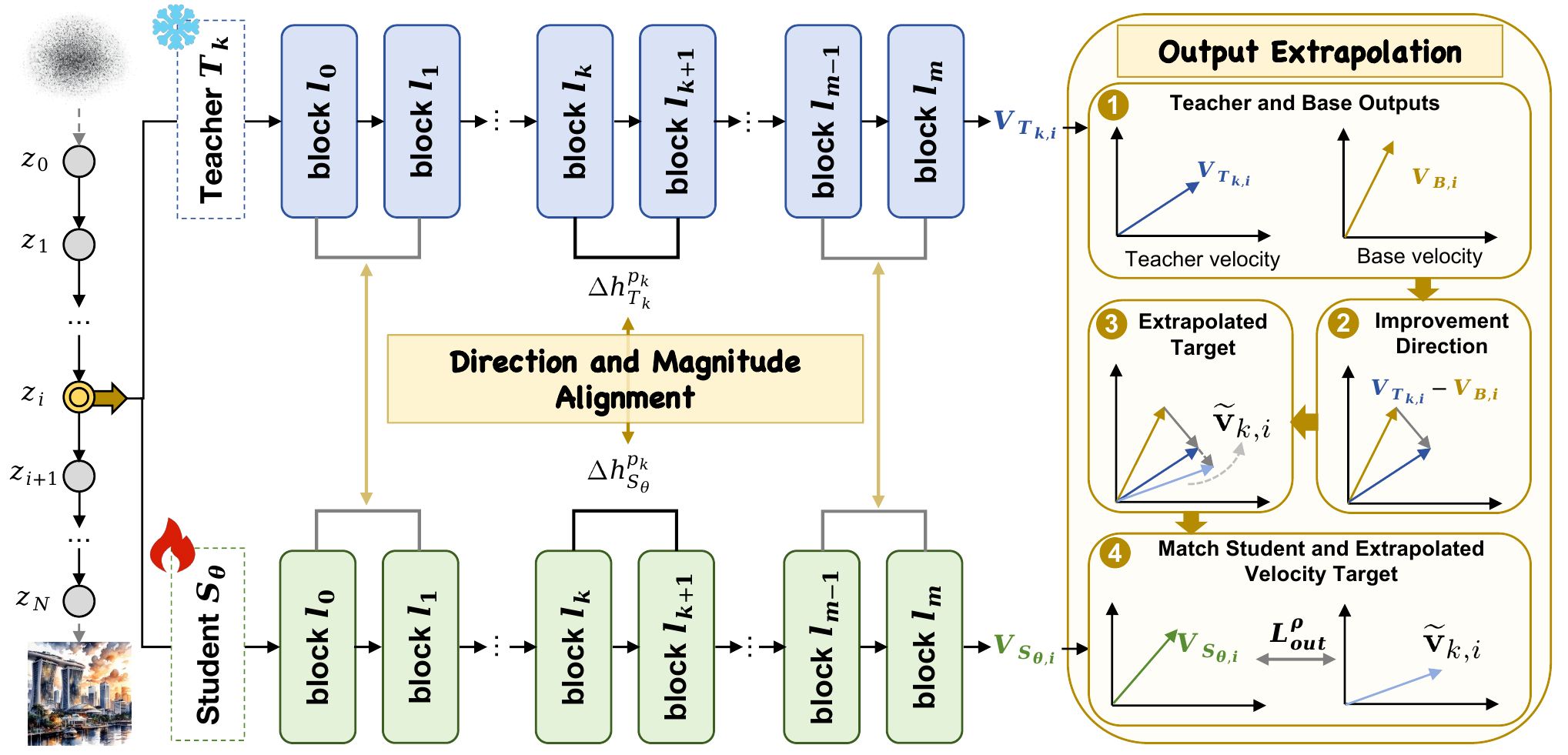
We propose STEP-OPD, an on-policy distillation framework for image generation that extends the student's learning target beyond the teacher and introduces explicit constraints on its internal representation evolution. Instead of treating the teacher as the final target, we use the velocity difference between each task-specific teacher and the shared base model as a direction for further learning and add a scaled version of this difference to the teacher velocity (output extrapolation). In addition, we align the direction and magnitude of representation changes between the student and teacher (representation change alignment), enabling the student to learn how representations are progressively transformed across network blocks.
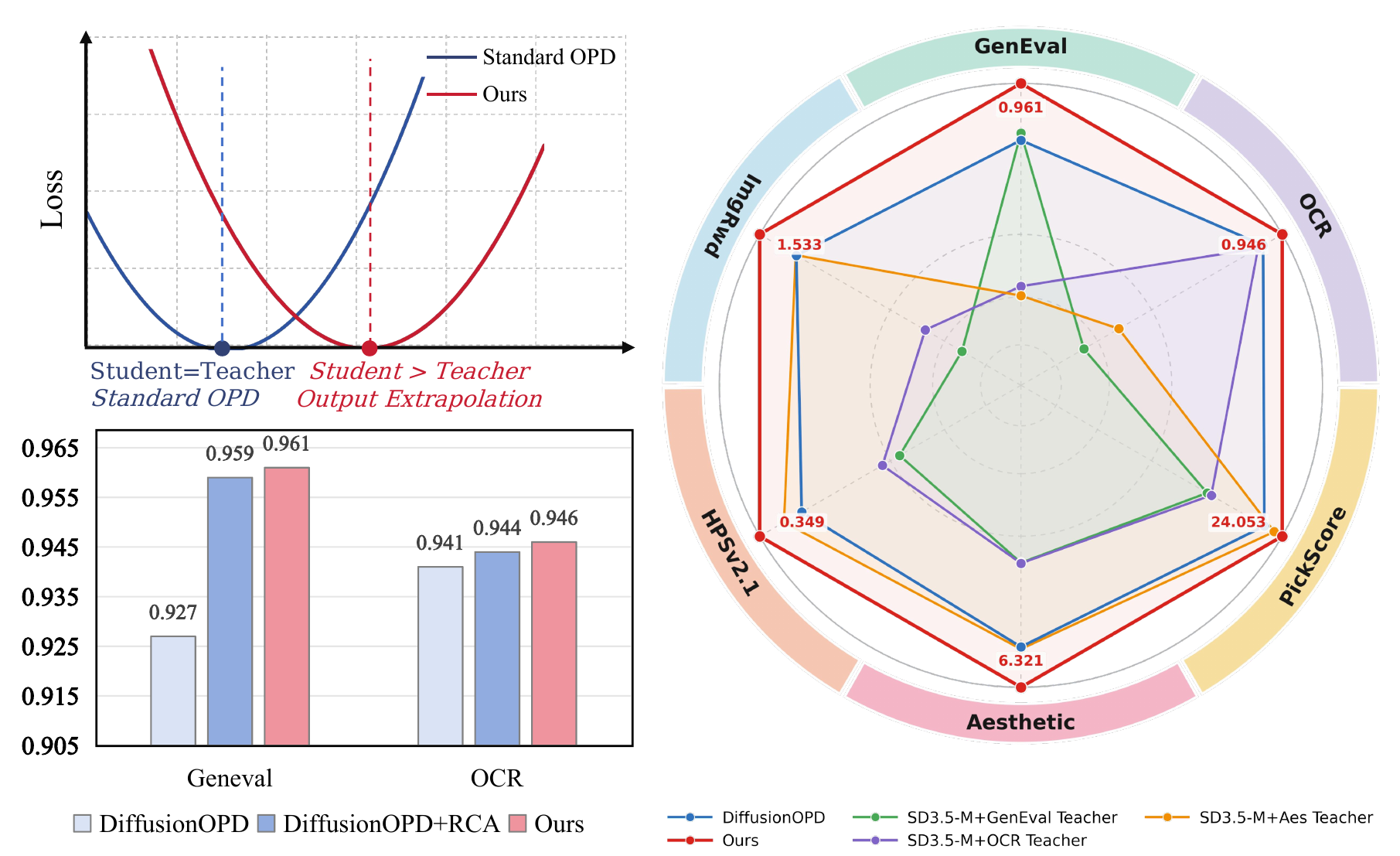
Experiments on compositional alignment, text rendering, and human preference show that our method consistently improves standard OPD methods. In particular, it increases the GenEval score of DiffusionOPD from 0.927 to 0.961, while also improving OCR and all preference-based metrics. The resulting unified student surpasses the corresponding single-task teachers across all three capability groups.
Built on the student's on-policy denoising trajectory, STEP-OPD adds two complementary objectives: task-specific output extrapolation (OE) and representation change alignment (RCA).
For each task teacher Tk and shared base B, construct
ṽ = vT + αk(vT − vB).
When α=0 this recovers standard OPD; when α>0 the target moves beyond the
teacher along the base-to-teacher direction. Coefficients are task-specific
(GenEval 0.01 / OCR 0.06 / Aesthetic 0.20) with a short warm-up.
Rather than matching absolute hidden states, align inter-block changes
Δh = hl₁ − hl₀ in both direction (token-wise RMS-normalized MSE)
and magnitude (log-RMS). Applied to 12 adjacent pairs covering all 24 Transformer blocks of SD3.5-M,
RCA constrains internal evolution without extrapolating internal targets.
STEP-OPD consistently improves both DanceOPD and DiffusionOPD across compositional alignment (GenEval), text rendering (OCR), and human preference, and further surpasses single-task teachers.
| Model | Sing | Two | Cnt | Col | Pos | C-Attr | Overall | OCR | Pick | Aes | HPS | ImgRwd |
|---|---|---|---|---|---|---|---|---|---|---|---|---|
| (a) Base Models | ||||||||||||
| FLUX.1-Dev | 0.778 | 0.427 | 0.628 | 0.649 | 0.068 | 0.253 | 0.467 | 0.496 | 22.648 | 5.737 | 0.292 | 0.796 |
| SD3.5-L | 0.703 | 0.389 | 0.525 | 0.628 | 0.140 | 0.265 | 0.442 | 0.635 | 21.973 | 5.299 | 0.264 | 0.688 |
| SD3.5-M+CFG | 0.869 | 0.495 | 0.569 | 0.715 | 0.148 | 0.355 | 0.525 | 0.559 | 22.398 | 5.389 | 0.280 | 0.853 |
| (b) Single-Task Teachers | ||||||||||||
| GenEval Teacher | 0.994 | 0.952 | 0.944 | 0.923 | 0.962 | 0.833 | 0.935 | 0.401 | 22.069 | 5.247 | 0.249 | 0.614 |
| OCR Teacher | 0.872 | 0.472 | 0.594 | 0.723 | 0.145 | 0.355 | 0.527 | 0.938 | 22.282 | 5.256 | 0.272 | 0.918 |
| Aes Teacher | 0.744 | 0.422 | 0.588 | 0.676 | 0.163 | 0.323 | 0.486 | 0.576 | 24.031 | 6.220 | 0.346 | 1.504 |
| (c) Diffusion/Flow RL & Multi-Objective OPD | ||||||||||||
| Flow-GRPO | 1.000 | 0.972 | 0.950 | 0.924 | 0.965 | 0.845 | 0.943 | 0.924 | 23.500 | 5.922 | 0.321 | 1.346 |
| DiffusionNFT | 1.000 | 0.968 | 0.954 | 0.937 | 0.963 | 0.818 | 0.940 | 0.910 | 23.800 | 6.010 | 0.331 | 1.490 |
| DanceOPD | 0.975 | 0.939 | 0.934 | 0.904 | 0.940 | 0.803 | 0.916 | 0.943 | 23.836 | 6.159 | 0.328 | 1.423 |
| + STEP-OPD (Ours) | 1.000 | 0.960 | 0.950 | 0.941 | 0.970 | 0.845 | 0.944 | 0.957 | 23.994 | 6.297 | 0.344 | 1.518 |
| DiffusionOPD | 1.000 | 0.962 | 0.938 | 0.926 | 0.948 | 0.790 | 0.927 | 0.941 | 23.941 | 6.208 | 0.340 | 1.503 |
| + STEP-OPD (Ours) | 1.000 | 0.990 | 0.988 | 0.957 | 0.980 | 0.853 | 0.961 | 0.946 | 24.053 | 6.321 | 0.349 | 1.533 |
Best in bold blue, second-best underlined. Evaluation at 512×512.
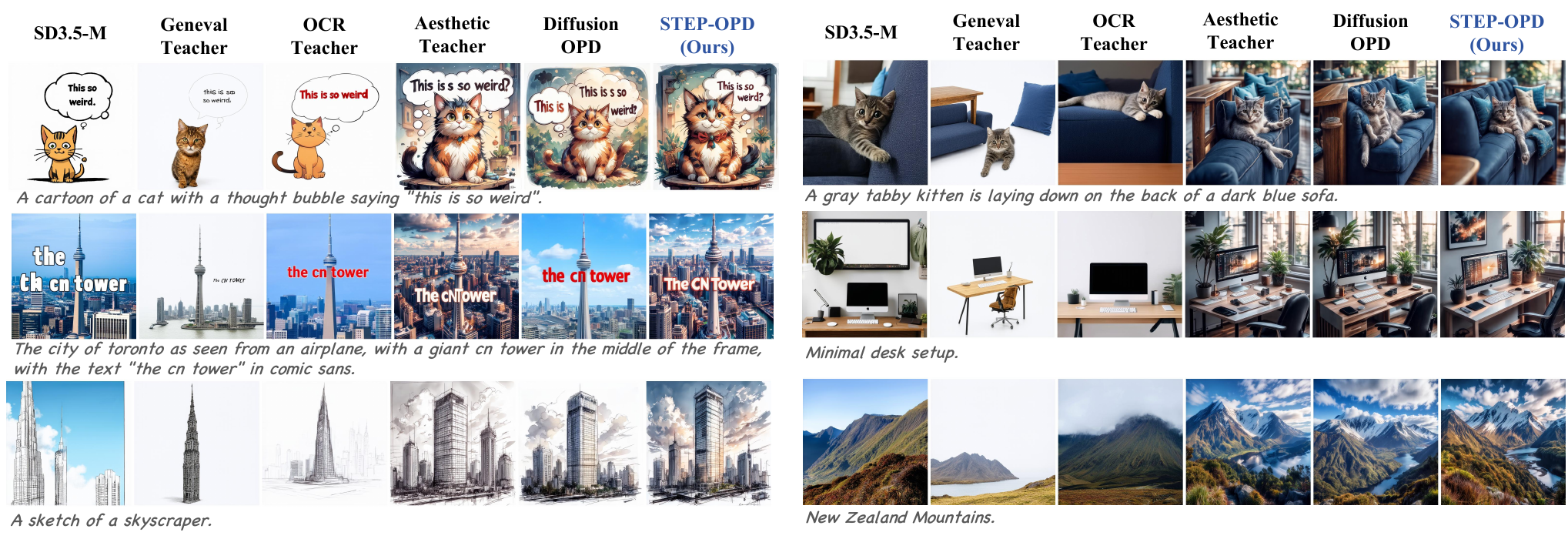
Across compositional alignment, text rendering, and human preference, STEP-OPD consolidates the strengths of specialized teachers with more accurate prompt adherence and text rendering while keeping strong visual quality.
RCA and OE emphasize complementary aspects of generation. Combining them yields the best balance across all three capability groups.
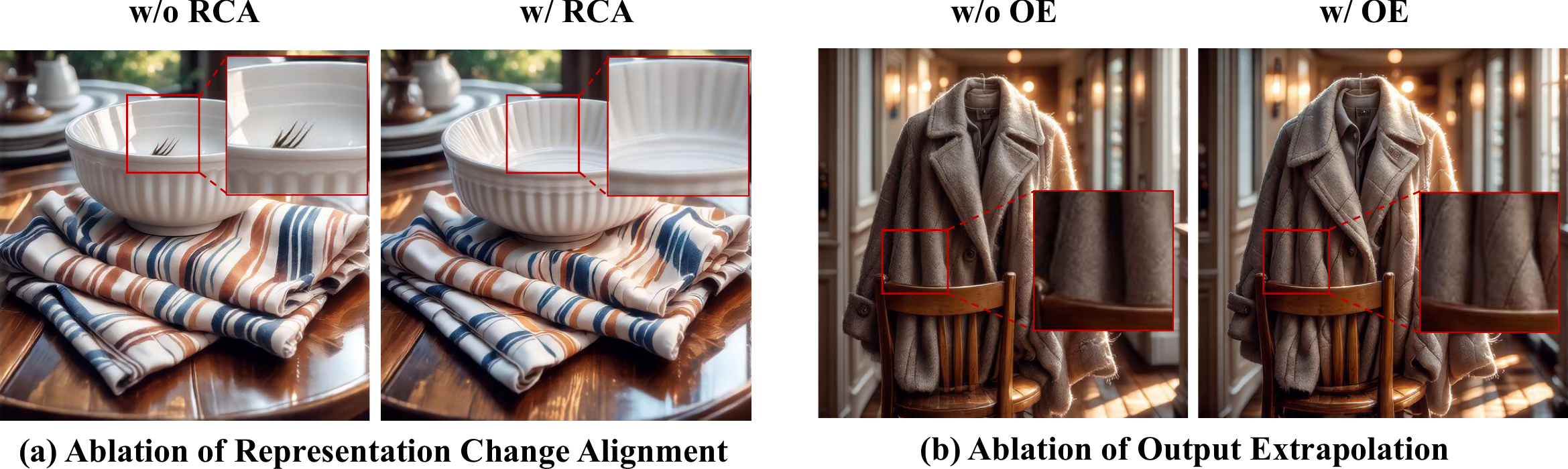
RCA lifts GenEval/OCR; OE drives preference gains; both together win overall.
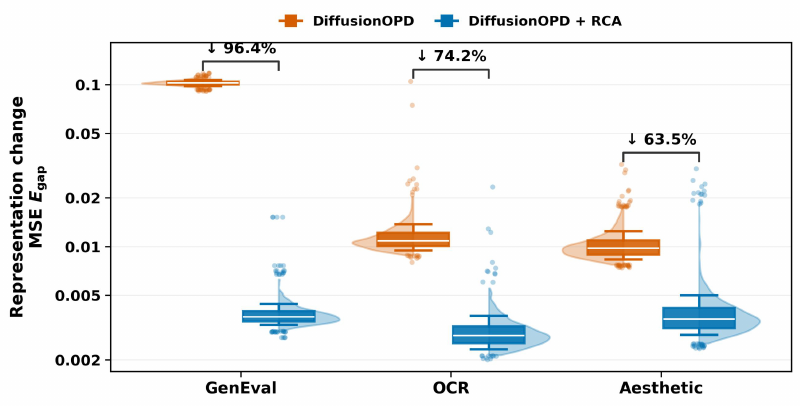
Metrics: GenEval / OCR / Aesthetic
Median paired relative reduction of representation-change gap under RCA.
Output matching alone leaves blockwise dynamics underconstrained.
@misc{wei2026stepopd,
title = {STEP-OPD: Rethinking Output Targets and Internal Dynamics
in On-Policy Distillation for Diffusion Models},
author = {Qingyan Wei and Guangzhao Li and Xiaobing Tu and Yinggui Wang
and Xiantao Zhang and Jinkui Ren and Xiaohong Liu and Linfeng Zhang},
year = {2026},
eprint = {2608.04887},
archivePrefix = {arXiv},
primaryClass = {cs.CV},
url = {https://arxiv.org/abs/2608.04887}
}